
Finding Desert Hot Springs Street Residents
Any street-by-street search in Desert Hot Springs has to keep location apart from identity. The address marks a physical situs. The APN marks a tax parcel. The assessment roll can name an owner, but only at the county counter. A deed lists parties to a recorded transfer. A lawful voter file concerns registration alone. Not one of those fields shows the full roster of people inside a home. Treat the workflow as a chain. Write down the input address, the date of each result, and the exact record number. Stop once a source answers the question. Move to another office only when the next relationship needs its own proof.
- Run the street number and name through Riverside County Property Search. Save the APN, situs, property type, transfer facts, and map link.
- Open the APN in RivCoView. Select the parcel and adjoining polygons, and save the assessor-map or tract-map reference.
- Take the address or APN to a Riverside ACR public office computer when the owner on the January 1 assessment roll matters. Online ownership is intentionally withheld.
- Search that name in the recorder index by document type and date. Read the deed or lien image for the legal description, grantor, grantee, and recording number.
- Use the county voter-file process only for a permitted purpose. Add city permits, code records, or an older criss-cross volume when a dated street history is the goal.
The county address search screen is the right first link for anyone starting a current parcel trail in Desert Hot Springs.
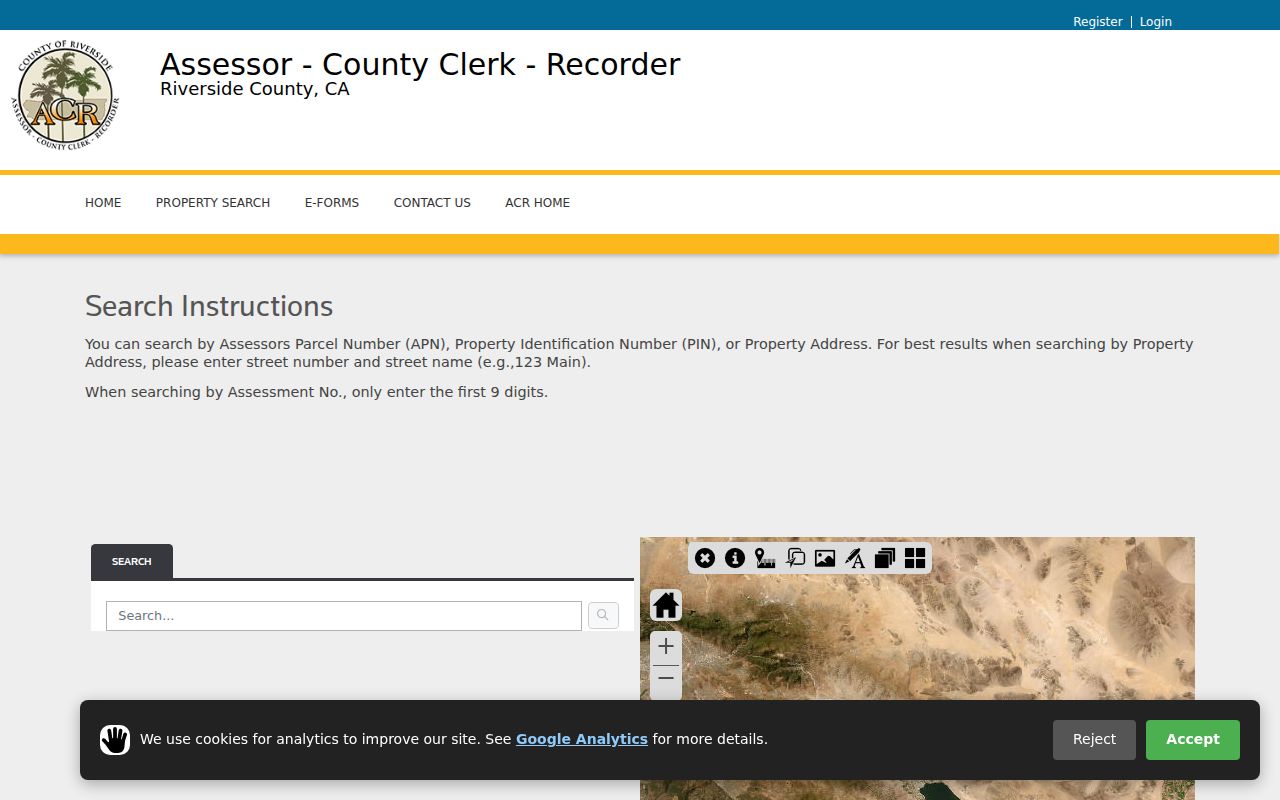
The property screen opens the chain with a parcel key. That key travels safely into later offices, far safer than a guessed resident name carried forward.
Desert Hot Springs Records Searchable by Street
An address record set reaches well beyond the property roll. Assessor and GIS tools place a parcel on the map. The recorder tracks transactions by name. City planning and code files document actions taken at a site. A controlled voter product may be arranged by street and precinct. If a local volume exists, a criss-cross directory can name a listed occupant for a given year. These fields work well side by side. Yet they should never be merged into a single claim about one person.
| Record set | Keeper | Street-scale clue | Access |
|---|---|---|---|
| Property Search | Riverside ACR | Address, APN, situs, assessment, transfers | Free online; owner absent online |
| RivCoView and map PDF | Riverside GIS and ACR | Parcel shape, adjoining APNs, dimensions, map references | Free viewer and maps |
| Recorded documents | Riverside ACR | Deed parties, dates, liens, legal descriptions | Free index; paid copies |
| Permits and code files | Desert Hot Springs departments | Project address, applicant, contractor, case date | Department or CPRA request |
| Street Index of Voters | Riverside Registrar | Qualified voter data arranged by address | Application and lawful purpose |
| Criss-cross directories | Library or archive | Listed occupant by address and year | Exact local runs unverified |
The parcel key links the map to assessment and deed research. A street name links an address to a possible voter entry or directory listing. Keep in mind that a permit applicant can differ from a tax-roll owner. A listed occupant can be different again. A street directory worth using records those roles openly instead of blurring the difference.
Desert Hot Springs Street Search Fields
Riverside Property Search takes either an address or an assessment number. County guidance suggests entering the street number and name, like "1234 Main." Don't overload the form with a city label. When a result supplies a PIN, the first nine digits can be used without the dash and check digit. Save the legal description too. A parcel number can change after a split or merger. The description anchors the parcel.
| Field | Required or mode | What the result can show |
|---|---|---|
| Address | Alternate text field | Situs, property type or use, parcel facts, assessment context |
| Assessment Number / APN | Alternate text field | Parcel identity and map relationship |
| Map browse or parcel click | GIS mode | Adjoining lots, dimensions, acreage, recorded-map references |
| Property result | After a match | Transfer date and document number, buildings, rooms, valuation, permits |
One Desert Hot Springs parcel result lists a property address, assessment number, APN or geocode, tax-rate area, acreage, DBA or business use, and legal description. It also includes map-book and page references, valuation date, transfer facts, and building details. Buttons lead to tax information, similar sales, value history, and a property report. Its history reaches back to a 1972 transfer. That early record can yield a deed lead predating the 1974 online recorder cutoff. The parcel result shows how much address context a street directory search can gather. It rounds that out before any office visit.
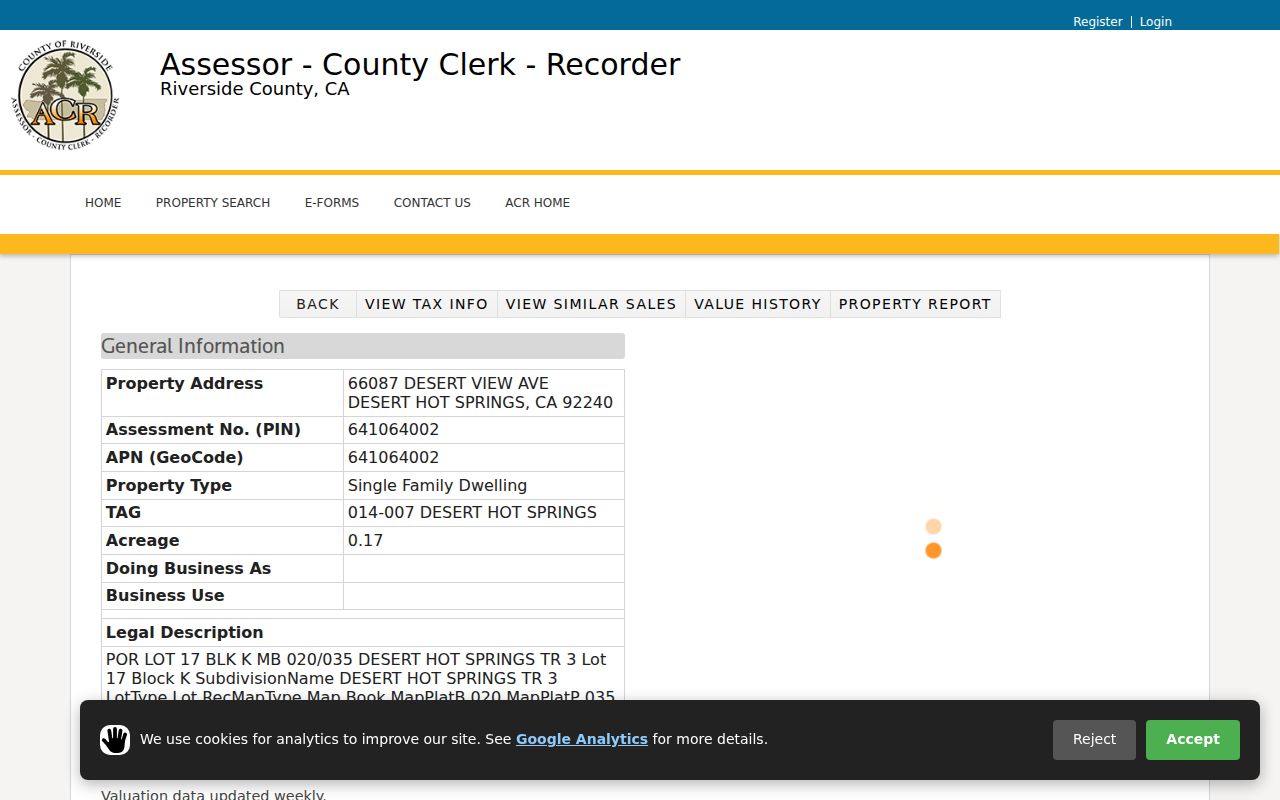
The result is a navigation aid, not a web display of the current owner.
Browse Desert Hot Springs Street Parcels
RivCoView is the map half of a Desert Hot Springs street directory. Search by address or a single APN. Pick the matching autocomplete result, then activate Select Parcel(s). The selection tool stays active while you click several adjoining polygons. The upper selection panel can list APN, owners, and address. It shows those fields where the viewer exposes them. The lower panel links to an assessor parcel map and tract maps. It also links to Google Maps, plus single or multiple parcel reports. Map layers add geography that plain text cannot. Address points, parcels, and APNs sit beside city and county boundaries. Census tracts and supervisorial districts appear too. So do spheres of influence, proposed or completed annexations, and flood districts. Tribal lands, school and water districts, and ZIP codes round out the set. Use those layers to test whether a postal address and a municipal service area truly coincide. That check settles many boundary questions fast. Riverside assessor map guidance explains the map-PDF route.
The map PDF gives lot lines, dimensions, acreage, street widths, adjoining APNs, and recorded-map details. It deliberately leaves out street addresses and ownership. Riverside assessor services covers the online, mapping, counter, and bulk-data channels, while RivCoView stays free but dynamic, so record the APN and map reference rather than trusting a transient screen state.
Desert Hot Springs Owner Names Online
Riverside publishes its January 1 assessment-list ownership information at county offices, yet the online Property Search result shows no owner identity. That asymmetry defines the local street directory. The free web route finds the parcel. The counter or microfiche supplies the assessment-roll name. The GIS map helps you select neighboring APNs, but its PDF is no owner list. Take a street address or APN to the office channel, ask which mailing or situs fields are releasable, and date the lookup. The mailing address is where tax mail goes. The situs address is the physical parcel. A mismatch can hint at an absentee owner, a trust, a manager, or another arrangement, but it never proves who occupies the site. ACR public-record guidance explains the public ownership and parcel-access boundary for Desert Hot Springs researchers.
Desert Hot Springs splits its assessor tools. Online mapping is one service, and ownership details stay with counter lookup.
Desert Hot Springs Street Deed Chain
Start with the name the ACR office supplies. Take that assessment owner into the recorder index and pick document types: deed, deed of trust, reconveyance, lien, release, notice, or map. Set a date window too. Each hit can show an indexed party, role, document type, date, and document number. Pull the instrument itself. It should carry the grantor, grantee, legal description, execution date, recording date, and any lot, block, subdivision, or map-book clue.
A deed chain is not a resident list. Sellers can linger after a transfer. Trusts, corporations, estates, and lenders all appear as indexed parties. Riverside's recorder index searches by name rather than address, so a lien hunt still needs the owner. Documents recorded before January 1, 1974 live at the ACR counter, with Gateway Riverside required for 1974 and earlier searching per the county detail.
- Copy the current owner name exactly, including middle initials, suffixes, organization spelling, and compound surnames.
- Run the name with a date range and deed-related document types, then note every candidate document number.
- Compare each legal description with the APN, lot, block, subdivision, and recorded map before accepting a match.
- Order a copy only after the index entry fits the parcel and date; use the earlier grantor or grantee as the next search target.
The ACR advanced document search exposes the actual fields and search-help rules.
County guidance keeps the handoff plain. An address or APN opens the trail, and the named recorder index carries it through every recorded document.
Desert Hot Springs Street Permit Files
City files add a dated layer to a street. Each city office holds a piece. A permit can identify a project address, applicant, contractor, plan check, and final inspection. It can also show a parcel or lot merger, easement, right-of-way dedication, tract or parcel map, lot-line adjustment, or street vacation. A code case can name a responsible party when that field is releasable. Request the permit card, application, issued permit, and final inspection history as separate existing records.
No renumbering or ZIP split is recorded. Continuity still breaks anyway. Annexation, a renamed road, or a parcel split can shift a Desert Hot Springs street label. So can rural-route conversion or postal standardization. Bridge an old street label with the legal description, APN history, and recorded maps. Permits and dated newspapers help too. The city planning and community development routes can say which jurisdiction owns the next file.
A permit applicant is not the owner. The builder and occupant may differ too. Compare permit dates with the assessment roll and deed chain before trusting a name. Then log the source agency and record number in the street directory notes.
Desert Hot Springs Voter Street Index
California My Voter Status is a self-lookup. A voter enters identifying inputs. The state returns that voter's registration status and election details. It cannot be used to browse a street. Riverside does publish a controlled Street Index of Voters, or Walking List. It is available for qualifying election, governmental, scholarly, journalistic, or political purposes under Elections Code section 2194.
The county product can be organized by street address. Entries may include registered voters and political affiliation. An optional telephone field often runs stale. The application identifies the requester, organization, geography, intended statutory purpose, security promise, signature, and payment. Commercial use is prohibited, sensitive identifiers and signatures are withheld, and confidential voters are omitted.
For a street-level question, do not substitute the personal California voter-status form for a county data application. The form checks one voter. A Walking List is a controlled county product with its own use rules.
Criss-Cross Directories for Desert Hot Springs Streets
A criss-cross directory flips the usual order. Its street section may turn an address into a listed occupant, business, or telephone entry for a printed year. No authoritative list of Desert Hot Springs Polk, Cole, or criss-cross publisher runs is available. Nearby Palm Springs and Coachella Valley volumes may still cover the city. School, phone, commercial, and postal markets cross city lines.
Ask before you travel. The Desert Hot Springs Library at 14380 Palm Drive, Riverside Local History Archives, Palm Springs Public Library, and the Coachella Valley History Museum can confirm the exact volume, year, and access condition. Photograph the title page and abbreviation key first. A listed occupant is a historical clue, not a statement about a current resident. For collection history and reading method, the Desert Hot Springs city directory page keeps the historical shelf in one place.
Street names change. Trust text-only address matches last. Search the legal description and neighboring parcels instead. A directory entry gains real strength when its year, page, source, and address pair with a deed or census record.
Desert Hot Springs Street Terms
Several Desert Hot Springs address terms sound alike yet point to different records. Defining them before a search keeps a clean-looking result from attaching to the wrong piece of land.
- Parcel
- A mapped unit in the assessment system, identified by an APN and used to connect property facts to a map.
- Situs address
- The physical location of the parcel, which can differ from the owner's tax-mailing address.
- Plat or recorded map
- A filed map that shows lots, blocks, dimensions, streets, or subdivision references used in a legal description.
- Criss-cross directory
- A reverse directory organized by street address, usually tied to a specific printed year.
- Legal description
- The land description that controls a deed, even when a street label or APN later changes.
Keep each field separate. The APN, situs, mailing clue, and legal description belong in distinct columns, and that discipline keeps the street directory useful for current parcel work, a prior-owner search, or a block-level map. It never claims more than the records show.
Desert Hot Springs Street Directory Limits
No Desert Hot Springs street directory lists everyone tied to a parcel. Guests, utility customers, mail recipients, and part-time occupants rarely appear in any public record. DMV residence data is closed off by the federal Driver's Privacy Protection Act. California law closes it off as well. Utility customer rolls are not a general address directory either. Even an owner's mailing address can point to a PO box, a trust, or a property manager. It can also point to a different property altogether.
A voter street index adds coverage but still has limits. It reaches only qualified registrants, and only lawful requesters may use it. Permit applicants, court parties, business agents, and owners of record may have no current home connection to the street. Match each directory result to a dated record. Confirm anything important with the custodian of the records. Stop once the source stops answering your question.
Lawful use. Desert Hot Springs address records support personal, lawful research, family history, property curiosity, and records correction. Using them to stalk, harass, intimidate, or harm someone can trigger California criminal and civil consequences.
Note: A Desert Hot Springs street directory result is a record relationship, not permission to contact or confront a person at a private address. Treat every entry as a clue. Verification belongs with the official custodian, not the curb.