
Desert Hot Springs City Directory Collections
A useful Desert Hot Springs city directory inventory must distinguish verified holdings from likely but unconfirmed shelves. Research located one freely digitized county volume, regional archive access, a documented Desert Hot Springs library history, and nearby genealogy resources. It did not locate an authoritative catalog showing exact Polk, Cole, or criss-cross runs for the city. That gap belongs in the table instead of being filled with a guessed year range.
| Collection | Years | Where held | Access |
|---|---|---|---|
| History and Directory of Riverside County | 1893–94 | Library of Congress | Free page images and downloads |
| Riverside Local History Archives | Item-level years vary | 3900 Mission Inn Avenue, Riverside | Research hours and appointment route |
| Desert Hot Springs Library local collection | Branch history from late 1940s; item years unverified | 14380 Palm Drive | Catalog and staff confirmation |
| Polk, Cole, or criss-cross volumes | Exact DHS runs not verified | Library, archive, or regional shelves | Confirm title and year before travel |
| Regional newspapers, yearbooks, and phone directories | Coverage varies | Palm Springs and Coachella Valley collections | Library databases, annuals, and research help |
The absence of a confirmed run does not make a search impossible. It changes the first move: ask for the catalog record, title page, publisher, and shelf location before treating a volume as evidence for Desert Hot Springs.
The 1893–94 Riverside City Directory Source
The strongest verified historical item is History and Directory of Riverside County, 1893–4, published by A. A. Bynon & Son through the Riverside Daily Press printing office. The Library of Congress viewer presents 360 scanned page images and downloads. The volume combines county history, biographical matter, and directory-style material, so a searcher should first identify the section and then transcribe the page image.
This county directory predates the incorporation of Desert Hot Springs. It can still provide regional names, businesses, biographies, and a snapshot of Riverside County when the county itself was new. It cannot be read as a modern Desert Hot Springs street roll. A locality, occupation, business, or neighboring place in the volume may be the bridge to a later family record.
Write down the printed name, locality or address, occupation or business, page number, and image link. OCR can miss initials, punctuation, and desert place names. Compare the result with a deed, newspaper, census schedule, or later directory before assigning it to a particular household.
Desert Hot Springs Before City Directories
Desert Hot Springs developed around desert homesteads and mineral-water resorts before it became a city. Riverside County was formed in 1893 from portions of San Bernardino and San Diego counties. Older land and court clues can therefore sit under a predecessor county or a historical township rather than under “Desert Hot Springs.” The city incorporated in 1963, which marks the beginning of municipal permit, council, license, and code series.
A printed city directory follows the market and geography of its publisher. A county volume may include a resort proprietor or a nearby settlement while missing a household in the modern city. Pair the entry with a legal description, deed, census enumeration district, local newspaper, or resort advertisement. The source date matters as much as the name.
| 1893 | Riverside County created; the digitized county history and directory anchors early regional research. |
|---|---|
| 1940s | The county library reports a Desert Hot Springs branch by the late 1940s, giving a likely route for community material. |
| 1963 | City incorporation begins the municipal record era; earlier city permits cannot exist. |
| 1950 census | The latest public federal census for current work that can supply household members, ages, relationships, and birthplace. |
Historical geography is not a minor footnote. It determines which county, township, library shelf, or archive catalog should be searched.
The Desert Hot Springs Library Directory Trail
The Desert Hot Springs Library is a Riverside County Library System branch at 14380 Palm Drive. The current 15,500-square-foot building opened in June 2021 and holds roughly 31,000 items. A community-built building was dedicated in 1956, and the branch moved to West Drive in 1972. Those building changes help locate old catalogs, vertical files, photographs, local newspapers, and commemorative publications that may not share one shelf.
The branch page does not publish a complete city-directory, yearbook, obituary, or telephone-book inventory. Ask staff to search under “Desert Hot Springs,” “Seven Palms Valley,” “Coachella Valley,” “telephone directory,” “criss-cross,” “Cole,” and “Polk.” Confirm whether an item is a printed volume, microfilm reel, licensed database, interlibrary loan item, or a referral to another branch.
The county library history page supplies the branch chronology.
The library history is useful because a branch move can change where local ephemera and older reference material are cataloged.
Desert Hot Springs City Directory Archives
Riverside Public Library Local History Archives at 3900 Mission Inn Avenue holds regional books, clippings, maps, photographs, bibliographies, and indexes. Published research hours are Tuesday through Thursday 2:00 to 6:00, Friday and Saturday 2:00 to 5:00, and Sunday by appointment. The archive contact is 951-826-5301. Confirm hours before travel because item access and staff availability can change.
The archive's county histories and 1912 biographical county history can help connect a surname to a place before a later city directory appears. Request a shelf or catalog check by exact name, locality, publisher, and year. A staff member can also tell whether a title is on open shelves, in a closed collection, on microfilm, or available through a partner library.
Riverside Local History Archives access details provide the current contact and research route.
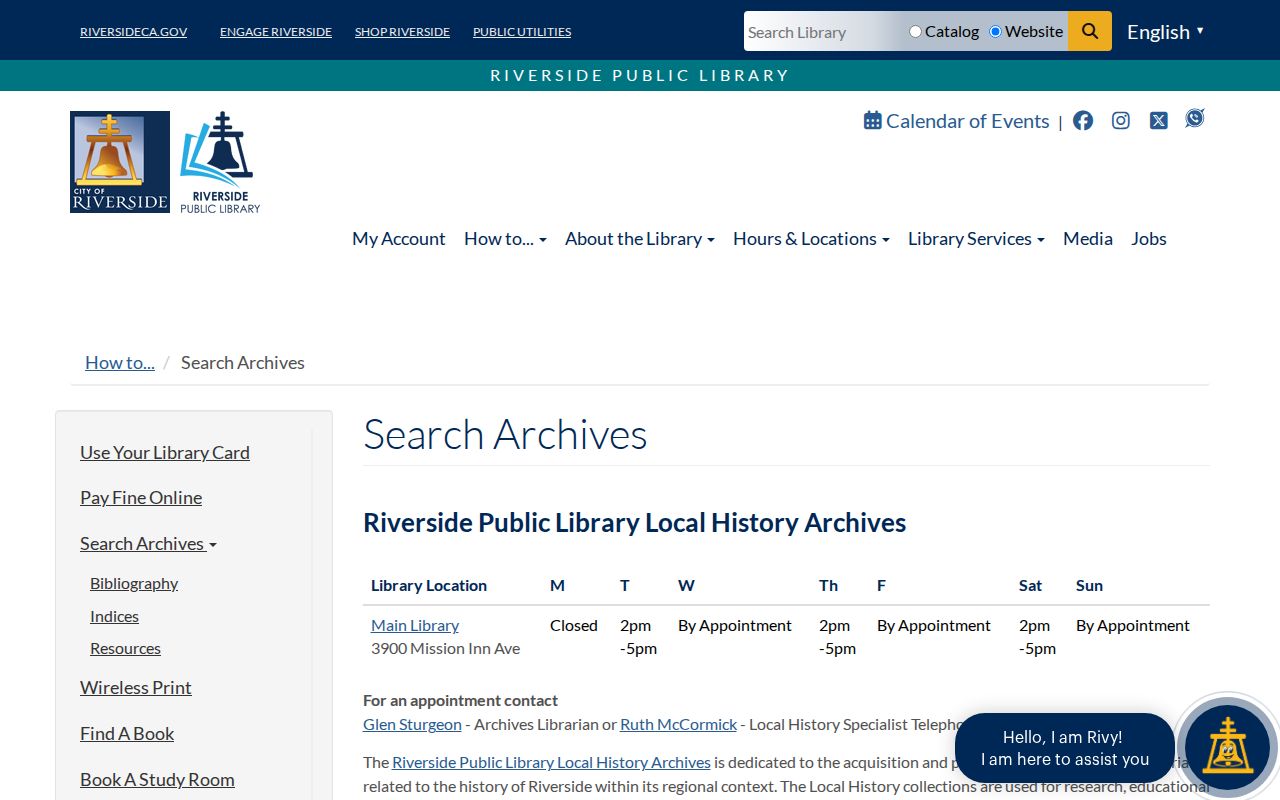
The archive page shows why a local history appointment can reach material that a broad web search never indexes.
Reading a Desert Hot Springs Directory
The 1893–94 scanned volume should be transcribed from the page image, not reconstructed from OCR alone. Record the printed name, occupation or business, locality or address, cross-reference, page number, and any abbreviation exactly as shown. Do not import later Polk conventions into a county volume. Spouse parentheses, owner symbols, telephone fields, and “r” or “b” marks belong only when the selected edition actually prints them.
| Printed name | Keep initials, punctuation, compound surnames, and spelling as printed. |
|---|---|
| Occupation or business | Use as a time-and-place clue, not as proof of a home address. |
| Locality or address | Copy the place label and distinguish a business location from a residence. |
| Cross-reference | Follow “see” entries and same-surname neighbors before deciding a match. |
| Image and page | Save the scan reference so another researcher can inspect the same line. |
- Criss-cross directory
- A reverse section arranged by street address rather than by surname; the local publisher and year must be confirmed.
- Householder index
- A name-focused list that may identify the head of a household or a primary contact, not every person present.
- Abbreviation key
- The volume's legend for short forms and symbols. Photograph or transcribe it before interpreting an entry.
- OCR
- Optical character recognition that turns a scan into searchable text but can misread initials, hyphens, and place names.
A scanned entry becomes stronger when the same address or person appears in a dated deed, census schedule, newspaper, or vital record.
Trace Desert Hot Springs Directory Households
Use each dated volume as a series of snapshots. Federal population schedules are public through 1950 under the 72-year rule, and 1960 becomes public in 2032. For Desert Hot Springs, older census work may require a historical township or enumeration district because the city boundary did not yet exist. A directory fills the years between census points, while a deed or obituary tests whether a move, death, or name change explains the gap.
- Start with the strongest dated clue: a full name, address, county, business, or family relationship.
- Transcribe the first matching directory entry and its page, locality, address, and abbreviation context.
- Check nearby same-surname entries and the reverse section, when the volume has one, for a household or neighbor clue.
- Pair the directory snapshot with the nearest public census year, then compare ages, relationships, birthplace, and occupation.
- Follow a move or disappearance into deeds, newspapers, obituaries, probate, cemetery material, or a later regional directory.
Disappearing from a volume can mean a move, death, a new spelling, a publication gap, a business closing, or simple nonlisting. It is not proof of any one event. Keep the source year and the next independent check beside the name.
For a current address chain, hand the parcel work to the Desert Hot Springs street directory; the historical volume belongs here, while present parcel ownership belongs with ACR.
Regional City Directories Beyond Desert Hot Springs
Desert Hot Springs names may appear in Palm Springs and Coachella Valley directories because postal, school, resort, and commercial markets cross city lines. Palm Springs Public Library provides digitized Desert Sun issues from 1934 to 1993, Palm Springs High School yearbooks, phone directories through its “Accessing the Past” route, Ancestry Library Edition, HeritageQuest, interlibrary loan, and librarian help at 760-322-7323. The page does not promise a complete Desert Hot Springs run, so search the catalog and ask staff.
The Desert Hot Springs Historical Society operates the Historic Rock House at 66050 Third Street. Its archive names photographs, newspaper clippings, artifacts, and oral-history interviews, with special-interest research by appointment. The historical society and Coachella Valley History Museum are referral points for community publications, resort history, and pioneer material, not assumed public resident rosters.
Use Palm Springs genealogy resources and the Desert Hot Springs Historical Society archive when the county shelf ends.
Missing Years in Desert Hot Springs Directories
No authoritative source located a verified Desert Hot Springs Polk, Cole, or criss-cross publisher run with exact years. Do not fill that blank with a neighboring city's dates. Ask the library or archive to confirm the title page, publisher, geographic coverage, call number, and whether the volume is open, on microfilm, or held elsewhere.
FamilySearch may hold California county naturalizations from 1831–1985, birth and death records from 1800–1994, marriages from 1849–1957, cemetery transcriptions from 1850–1960, and image-only probate files from 1833–1991. Sign-in, affiliate-library, or FamilySearch Center limits can apply, and a collection-level listing does not prove that a Desert Hot Springs volume is present. Use a catalog record and image group before citing it. For government-era material, check the California State Archives catalog and reference route.
When a directory year is absent, combine the last known entry with the next available census, deed, newspaper, obituary, permit, or regional phone book. The gap is part of the evidence, not a reason to invent a continuous household story.
Desert Hot Springs Directory Newspapers
Newspapers and obituaries often carry the names that printed directories miss. Search the California Digital Newspaper Collection, Chronicling America, library-licensed databases, and regional Desert Sun coverage for addresses, spouses, parents, civic roles, resort ownership, and development events. OCR is a lead only. Hyphenated names, initials, and desert place names need a page-image check.
School yearbooks are a practical route for former classmates. Ask the Desert Hot Springs Library and Palm Springs Unified School District or archive contacts which annuals are open. Use an alumni organization's voluntary contact channel rather than turning a historical name into a current address hunt. Funeral-home notices can add family clues, but probate, death, and vital records are the stronger confirmation.
A careful Desert Hot Springs historical-directory search ends with source, date, page, geography, and an independent record. That habit makes a thin collection useful and keeps an unverified directory line from becoming a false resident claim.
Note: County and regional shelves can outlive a printed publisher, so search the keeper and the geography before assuming publication stopped.