
Finding Desert Hot Springs Residents
A single public roll does not list every person in Desert Hot Springs. An assessor result describes a parcel and assessed facts, an office lookup supplies the current assessment-roll owner, and a recorded instrument shows a party to a transaction. A voter record is controlled data, not a reverse directory. The library and regional archives add past households, while court, probate, obituary, business, and license records answer narrower questions.
A Desert Hot Springs residents directory is therefore a set of record paths, each with a defined custodian and a limited answer.
Start with the strongest fact already known. An address can yield an APN, a map, and a deed lead. A full name can be tested against court, recorder, entity, or license indexes. An old date points toward census, newspaper, or directory material. The result is a better Desert Hot Springs residents directory search because each step preserves the difference between an owner, a party, a registered voter, a business contact, and a household member.
- Normalize the street line with an address-to-ZIP check, then keep the exact spelling and postal city.
- Run the county address search by street number and name, or by APN, to obtain parcel facts.
- Open the parcel in RivCoView, note adjoining APNs and the recorded-map reference, then use an ACR public counter when ownership must be checked.
- Search the recorder by the owner name, document type, and date range; read the instrument rather than treating an index line as present occupancy.
- Choose the next source for the question: a restricted voter-file route for a lawful purpose, a court case number, a vital-record application, or a library and archive collection for history.
Desert Hot Springs Records Desks
Desert Hot Springs records sit across city, county, and state custodians. The Riverside County Assessor-County Clerk-Recorder combines parcel, recorder, clerk, marriage, and local vital services. The city clerk keeps city-created correspondence, council material, permits, licenses, and code records. The Registrar of Voters controls voter-file products, while Riverside Superior Court keeps case indexes and registers of action.
The best office depends on the relationship being tested. ACR can connect an address or APN to an assessment-roll owner at an office computer. The city can disclose an existing permit or request record, but an applicant is not automatically an owner or occupant. A public court result confirms a filed case, not a person's entire life. These distinctions keep a Desert Hot Springs residents directory useful without turning one field into a claim it cannot support.
Riverside County ACR
Palm Desert counter
38-686 El Cerrito Rd, Palm Desert
8:00 a.m. to 4:30 p.m.
Desert Hot Springs City Clerk
Municipal records and CPRA route
City clerk email: cityclerk@cityofdhs.org
760-329-6411
Municipal records contact
Riverside County Registrar
Voter data and election records
2720 Gateway Drive, Riverside, CA 92507
951-486-7200, Monday to Friday 8:00 to 5:00
The Riverside County Assessor-County Clerk-Recorder service hub is the starting point for county services. Its branches and products differ, so check the live location page before making a trip.
Note: A county office can identify the record custodian without proving that every person connected to a parcel lives there.
Desert Hot Springs Resident Address Trail
Riverside Property Search is an address-to-parcel tool, not an online owner directory. Enter the street number and street name, or use an assessment number/APN when one is known. The result can expose the situs, property type or use, assessed land and improvement values, sale or transfer facts, permits, and a linked assessor map. It intentionally withholds the owner name online. ACR says the owner can be identified by address or APN at its public office computers or microfiche.
RivCoView adds the map layer. Search by single APN, multiple APNs, or address; activate Select Parcel(s) to click the subject and adjoining polygons. The upper panel can list APN, owner, and address where available, while the lower panel links an assessor parcel map, tract maps, map services, and reports. County layers include parcels, address points, city and county boundaries, annexations, ZIP codes, census tracts, and school or water districts.
| Search field | What to enter | What it contributes |
|---|---|---|
| Address | Street number and name, such as 1234 Main | Matches a situs and returns parcel facts |
| Assessment Number / APN | County parcel format from a result or map | Stable parcel key for GIS and counter work |
| Map browse or parcel click | Single APN, multiple APNs, or selected polygons | Shows adjoining parcels and recorded-map context |
When the address and postal city do not match the incorporated boundary, preserve both facts. A “Desert Hot Springs” mailing line can reach unincorporated Riverside County. The parcel boundary, not the postal label, determines which city or county department handles permits and code records. The inspected ACR parcel result demonstrates the level of detail available without placing ownership on the web.
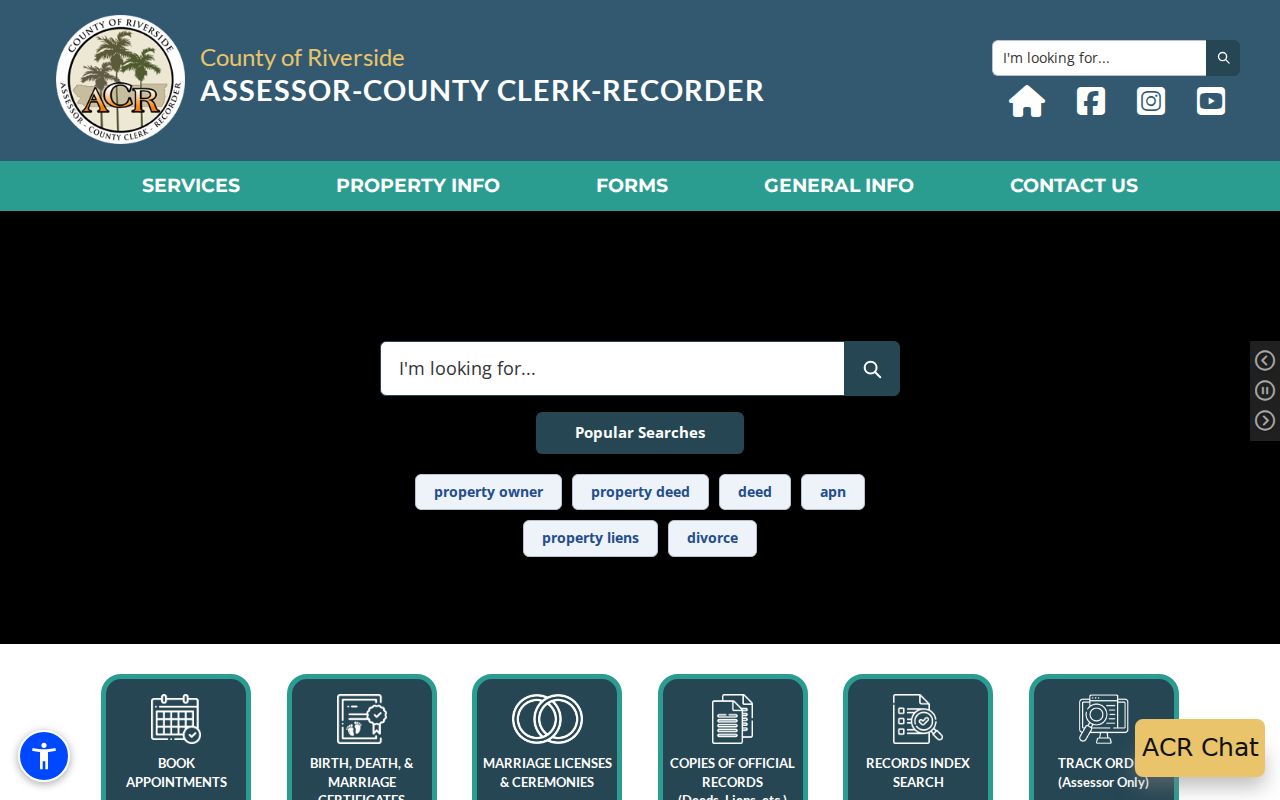
The county service screen reinforces the key handoff: the web can resolve the property, while the ACR counter supplies the public assessment-roll ownership lookup.
Desert Hot Springs Recorder Records After 1974
The Riverside recorder index is online from January 1, 1974. The county clerk index reaches back to January 1, 1893, so the word “records” covers two different clocks. A deed, deed of trust, reconveyance, lien, notice, release, or map is a recorder trail. A fictitious business name, marriage license, or clerk registration follows a different product line. A blank online recorder result may mean “before the cutoff,” not “never recorded.”
The advanced document search accepts a document number, recording-date range, name, document types, and an advanced name-search control. Search help supports exact order and wildcard behavior. Operators include plus for a required term, minus for exclusion, a sound-alike symbol, a single uncertain character, and a prefix wildcard. Use the owner name for a lien search because the recorder index is not an address search.
- Recorder index: January 1, 1974
- Recorded parties, document type, recording date, and document number; use ACR books, media, or a staff search for older material.
- Clerk documents: January 1, 1893
- Fictitious business names, marriages, and clerk-filed records; use the county counter or the relevant product request when an online result is absent.
- ACR copies: current index entries
- Instrument images or certified copies; order only after confirming the party, document type, and recording number.
Online recorder searches are free. Copies cost $8 for the first page, $1 for each additional page, and $2 for certification per document. Online copy orders average about 48 hours plus a card fee. No refund follows once a copy is made, so confirm the party, document type, and recording number before ordering from the ACR advanced document search.
Current Desert Hot Springs Resident Sources
A current Desert Hot Springs residents directory is best read as a set of relationship records. The sources below do not all list residents, and none should be treated as a complete household roll. They are useful when the question is narrow: who is tied to a parcel, who appears as a recorded party, which person verified a voter status, or which business and public license connects a name to a place.
| Source | Relationship shown | Keeper | Access |
|---|---|---|---|
| Property Search and RivCoView | Parcel, situs, assessment, sales, permits | Riverside ACR and GIS | Free online; owner withheld online |
| Assessment roll | Owner at the assessment date | Riverside ACR | Office computer or microfiche |
| Recorder index | Party to a deed, lien, or notice | Riverside ACR | Free index; paid copies |
| Voter status and voter file | Verified status or qualified registration data | California SOS and Riverside Registrar | Self tool or restricted application |
| City permits and boards | Applicant, contractor, public official, or civic speaker | Desert Hot Springs | Existing records or public agendas |
| Business and professional indexes | Entity, agent, license, or business address | California SOS and DCA | Free public searches |
Use the source closest to the question. A property result begins an address chain. The Desert Hot Springs resident lookup approach is better when a name must be checked across court, vital, probate, or license records. A city directory answers an older household question rather than a current ownership one.
Desert Hot Springs Court Record Searches
Desert Hot Springs cases route through Riverside Superior Court. The public portal covers civil, criminal, family, probate, and traffic material, with branch and record dates that vary. A case-number search is free and can open a register of actions. A civil, criminal, or traffic name search uses credits. Current and next-seven-day calendars show hearing details, and nonconfidential documents can be downloaded for a fee.
Coverage includes Palm Springs civil and small claims from September 1993, Indio civil series from May 1991 or September 1993, family law from April 1992, probate mostly from July 1994, and criminal series beginning around 1990. Purged files may be absent under Government Code section 68152. Sealed, juvenile, adoption, and other confidential records remain closed.
For a clerk search, the published charge is $15 per name. Portal name credits range from $1 for one name to larger bundles, and downloads use a per-page schedule. The Riverside court access page explains the live price and branch rules before a paid lookup.
A Desert Hot Springs Business Records Trail
Resorts, spas, lodging, construction, and personal-service businesses create a useful Desert Hot Springs people trail. Start with California Secretary of State bizfile by entity name or file number. Its detail can show formation or registration dates, jurisdiction, standing, street and mailing addresses, agent for service, due dates, and available filings. A business address identifies a corporate relationship, not a home or household.
Pair that entity with a Riverside fictitious business name filing, a city license or permit, and a professional lookup when a person is connected to a regulated service. The Department of Consumer Affairs search accepts board, license type, number, business name, first name, last name, or registry number. Contractors, real-estate, healing-arts, cosmetology, HVAC, pool, solar, and hospitality-related records can corroborate a public business association without turning a license into a personal address claim. California bizfile shows the state entity search fields and result path.
The entity search is most useful when a name is paired with an entity number, status, filing date, or agent relationship. California DCA license search adds a second independent identifier when the name is common or the business uses a trade name.
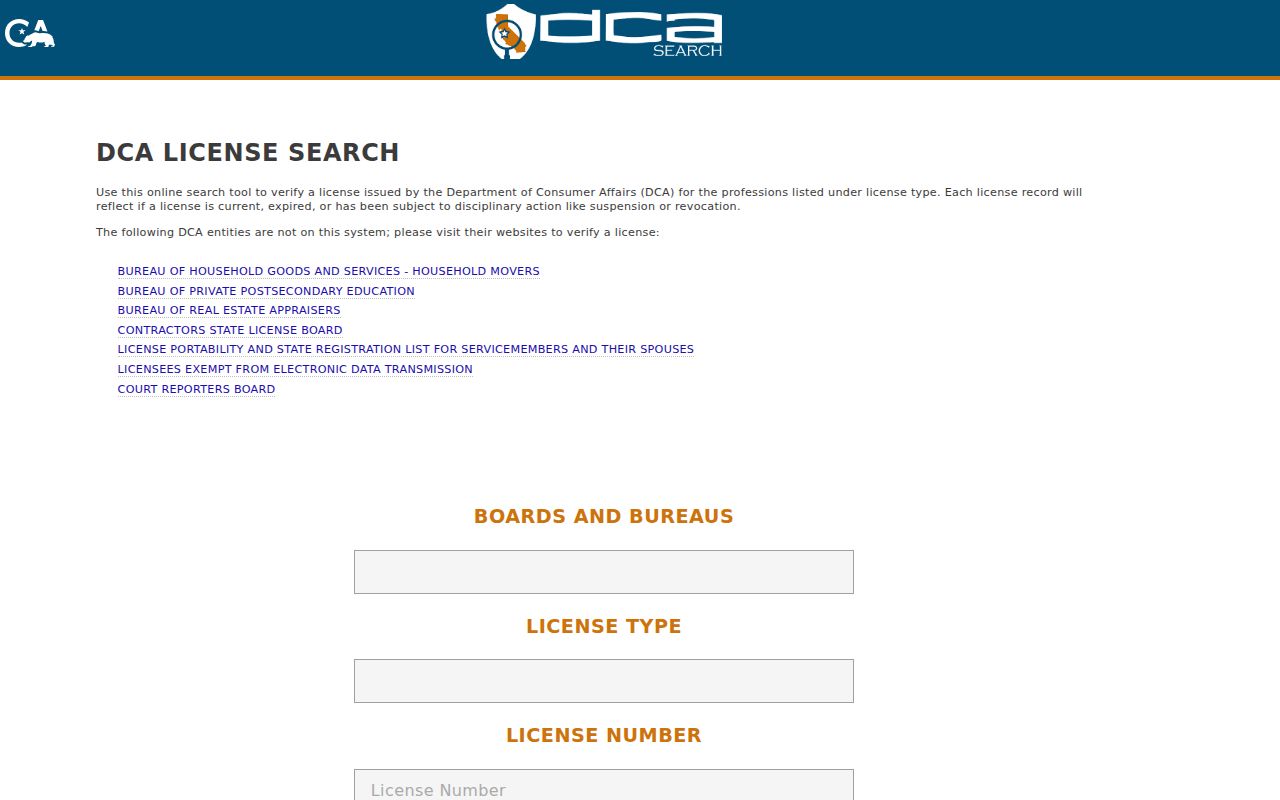
A license result may show status, dates, public address, and discipline links. It still describes a license relationship, not a full resident record.
Narrow Desert Hot Springs Public Records Requests
The city clerk is the route for council records, ordinances, resolutions, contracts, election filings, correspondence, permits, code files, and other city-created material. The city uses NextRequest, where completed requests can be searched before a new request is sent. A useful request names the department, a narrow date range, a street or APN, a person or business, and the exact record type. A municipal entry can add a useful line to a Desert Hot Springs residents directory when its department, date, and record type are kept clear. California Public Records Act requests may be oral or written; a written scope preserves the request history. The agency generally has 10 calendar days to determine whether responsive disclosable records exist, with a possible 14-day extension for unusual circumstances. Production takes longer, and the city need not answer a research question or create a new compilation.
- Search prior NextRequest records for the department, address, APN, project, or name.
- Ask for existing permit cards, applications, issued permits, final inspections, or code case records separately.
- State whether inspection, electronic copies, or a specific document is wanted, and allow releasable portions to be separated.
- Use the custodian's response to narrow a follow-up instead of asking the city to identify a person.
The Desert Hot Springs City Clerk page identifies the municipal contact route.
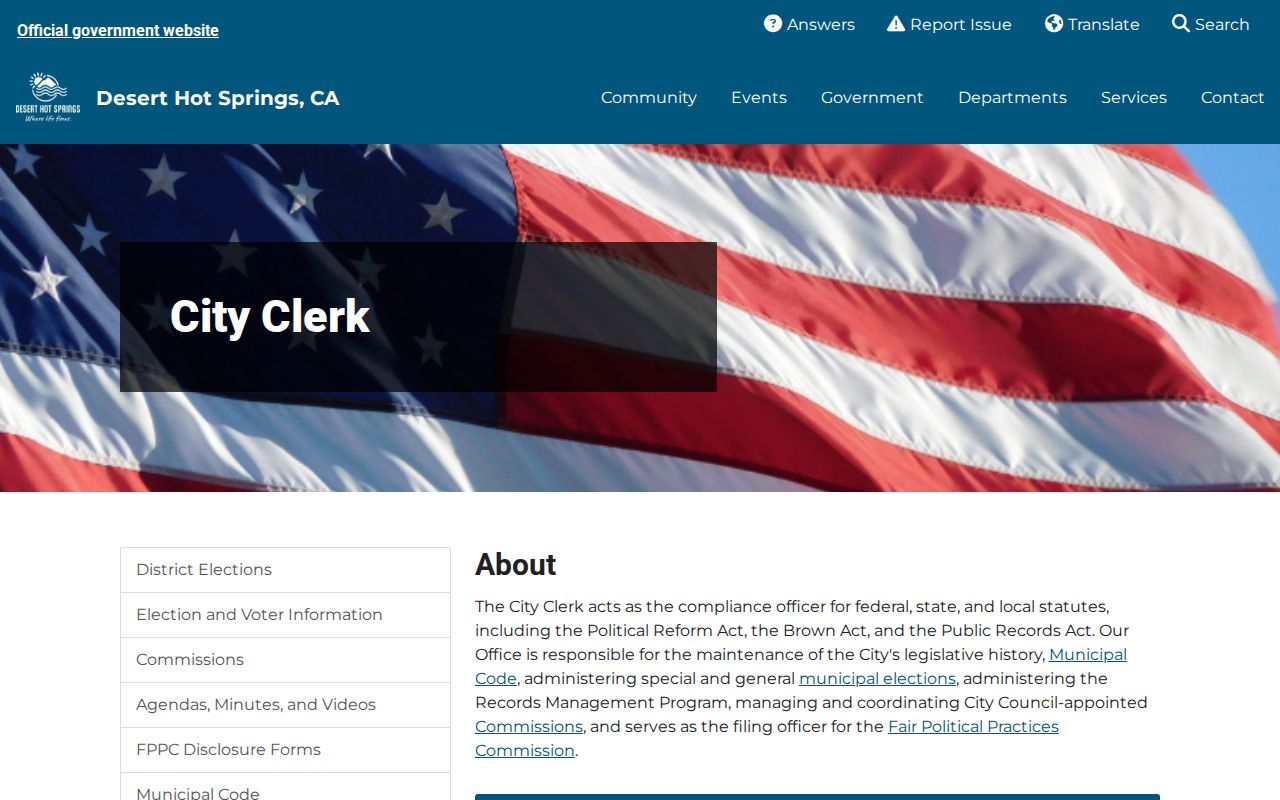
The city contact screen is a reminder that municipal records are evidence about a city action, not a citywide resident list. The city's NextRequest portal also lets a researcher review prior request titles before sending a new scope.
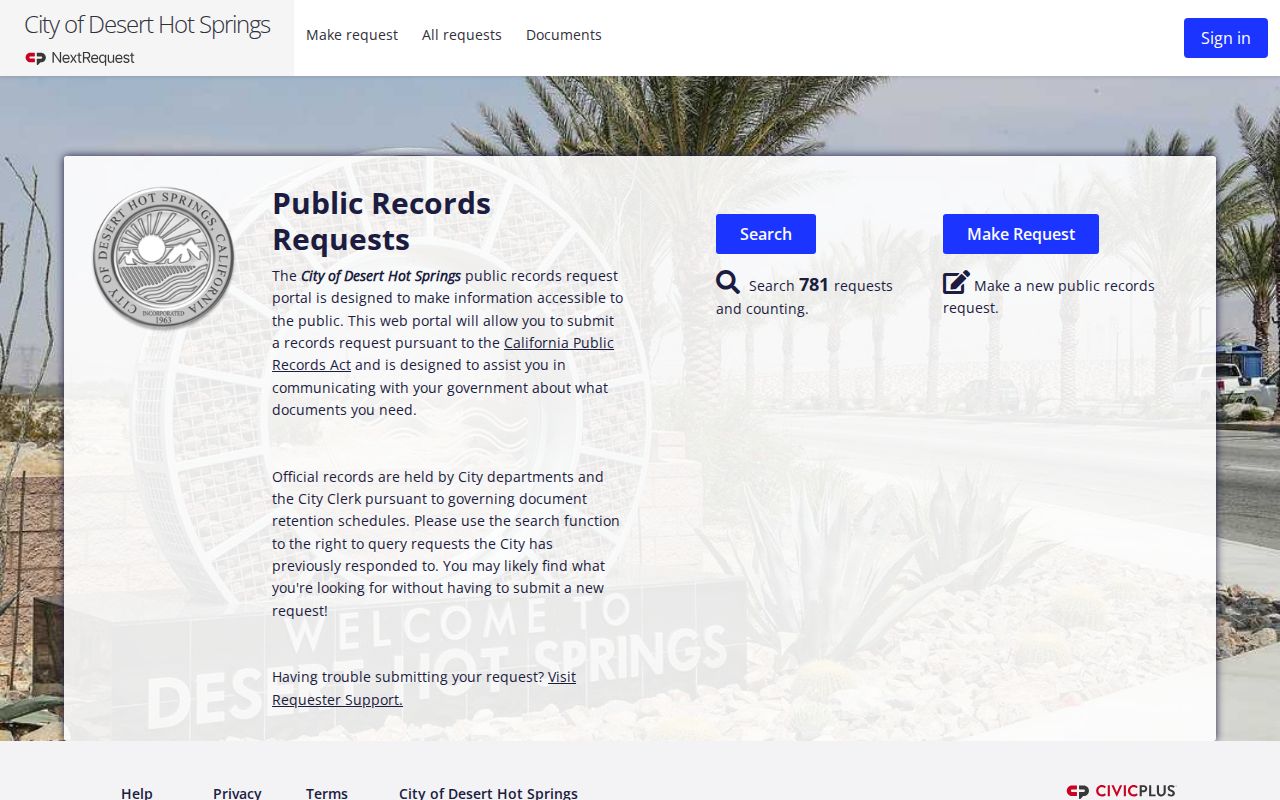
Searching earlier requests can reveal the right department and record label before a new CPRA scope is submitted.
Official Desert Hot Springs Resident Records
Official records and commercial people-data products solve different problems. A county index is close to the source but narrow in purpose. A compiled profile may combine many sources, but the match, date, and origin can be hard to inspect. A Desert Hot Springs residents directory search should use the primary custodian when the result matters to family history, an estate, a records correction, or a scam check.
| Route | Strength | Limit |
|---|---|---|
| County or city record | Named custodian and defined field | May omit residents, redact fields, or stop at a date |
| State lookup | Authoritative status, license, or entity data | Each tool serves a narrow record type |
| Historical collection | Context for older names and addresses | OCR, gaps, and old geography require checking |
| Commercial compiled profile | May gather scattered clues | Can be stale, costly, or merge names incorrectly |
A compiled result never overrides a sealed court file, Safe at Home protection, confidential voter status, or an official correction. Keep the source URL, result date, and record number so another researcher can repeat the check.
Desert Hot Springs Historical Resident Records
The historical side of a Desert Hot Springs residents directory begins with county and regional material because the city incorporated in 1963. The verified free digitized item is History and Directory of Riverside County, 1893–4, published by A. A. Bynon & Son through the Riverside Daily Press printing office. The Library of Congress presents 360 page images. It is countywide, so it offers regional names, businesses, biographies, and context rather than a modern house-by-house list.
Riverside Public Library Local History Archives at 3900 Mission Inn Avenue offers regional books, clippings, photographs, maps, and indexes by appointment. The Desert Hot Springs Library at 14380 Palm Drive can search its catalog and vertical files for local newspapers, phone books, yearbooks, obituaries, and directories. The branch history gives useful custody clues: a branch existed by the late 1940s, a community-built building was dedicated in 1956, the branch moved to West Drive in 1972, and the current Palm Drive building opened in June 2021.
For the full collections, reading method, and the difference between a city directory and a criss-cross volume, use the Desert Hot Springs city directory collection guide. Old addresses should be paired with deeds, census schedules, newspapers, and maps rather than read as a stable modern city boundary.
Before Desert Hot Springs Became a City
Riverside County was created in 1893 from parts of San Bernardino and San Diego counties. A name or land record from the same physical area may therefore sit under a predecessor county. The 1893–94 county history and directory is an unusually useful bridge: it coincides with the new county and supplies a digitized name source for a region that predates Desert Hot Springs.
Desert Hot Springs developed around desert homesteads and mineral-water resorts, then incorporated in 1963. City permits, council minutes, licenses, and code series cannot predate the municipal government. Earlier address research belongs with county land and assessment records, federal census schedules, newspapers, private resort material, and legal descriptions. The city's first public bathhouse and early street work are part of local history, but a modern street label may not be the right key for a homestead-era search.
- 1893: Riverside County formed; the founding-era county history and directory becomes a regional name source.
- 1940s: Desert Hot Springs library presence is documented by the late 1940s, useful for locating community ephemera.
- 1963: Desert Hot Springs incorporated; city-created record series begin after municipal government exists.
- 1974: Online Riverside recorder indexing begins; older deed work shifts to office books, media, or staff searches.
That timeline prevents a common error: treating a missing city record as proof that a person or structure did not exist.
Protected Desert Hot Springs Resident Records
California public access has limits. Safe at Home gives qualifying survivors and specified protected workers a substitute mailing address and mail forwarding. Confidential voters can have residence information shielded in qualifying life-threatening circumstances. Recorded documents, voter signatures, driver-license and Social Security data, and DMV personal information have separate protection rules.
California's DROP deletion portal began accepting resident requests January 1, 2026. Registered data brokers began processing requests August 1, 2026 and must check at least every 45 days. DROP can affect broker-held names, ZIPs, phones, emails, and similar identifiers, but it does not erase a valid public deed or court record. The Safe at Home program explains the address-confidentiality route. California My Voter Status is a personal verification tool that asks the voter for identifying details and returns that voter's status; it is not a public neighbor directory.
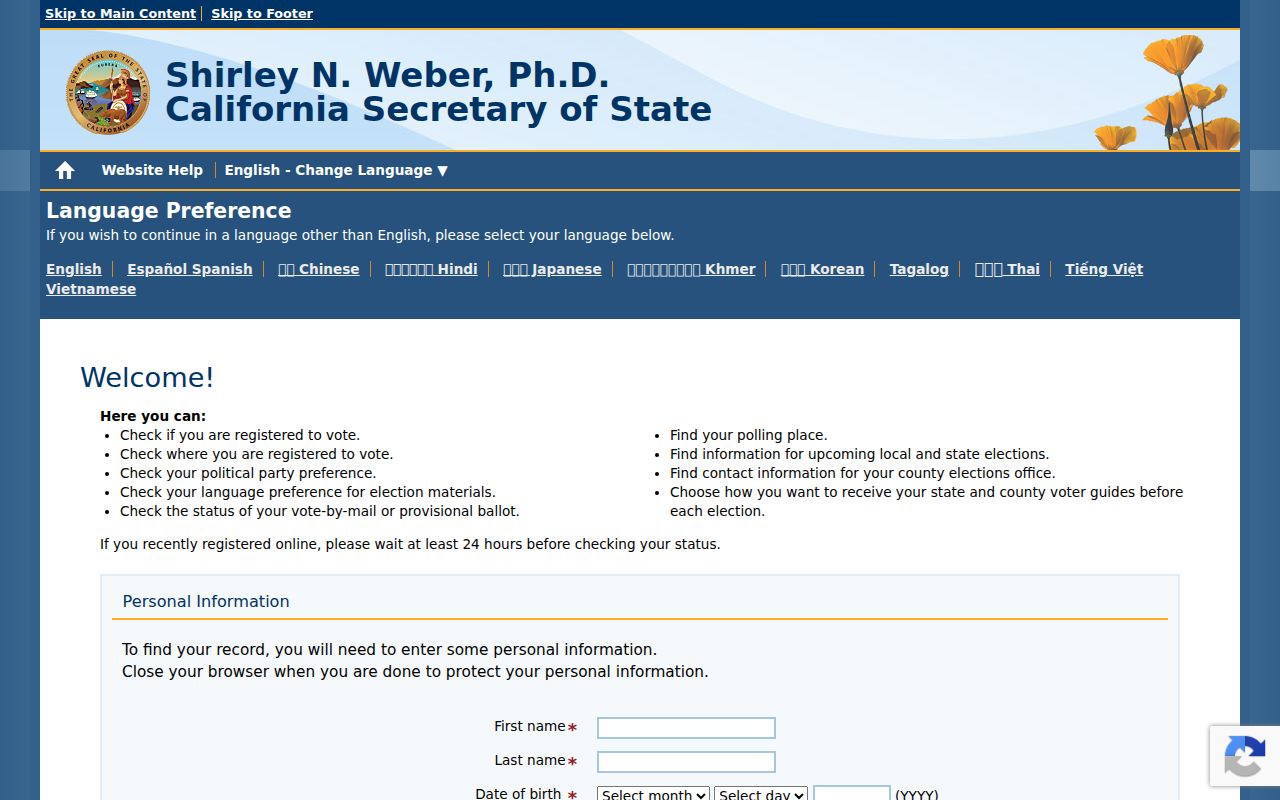
The voter-status form illustrates why a status check cannot be reversed into a street list.
Lawful personal use. Records can support family history, civic research, estate work, and personal safety checks. Never use a Desert Hot Springs residents directory to stalk, harass, intimidate, or harm another person.
Desert Hot Springs Directory for Heirs
Some searches need a human-use route rather than a broad name hunt. Probate petitions, notices, obituaries, and the Riverside court record can point toward an heir or estate. An obituary supplies a lead about kin, a last residence, or a service, but the court file or vital record is the better confirmation. The State Controller's unclaimed-property search is another free name route when a person or estate may have property held by the state.
Former classmates are better approached through school yearbooks, the Desert Hot Springs Library catalog, Palm Springs regional collections, and an alumni group's voluntary contact channel. Birth-family searches belong to California's official adoption consent process, not public birth-certificate fishing. Business owners can be separated by entity, FBN, license, and parcel numbers. Each path keeps the person's own records and consent rules in view.
Regional materials matter because Desert Hot Springs names can appear in Palm Springs and Coachella Valley newspapers, phone directories, yearbooks, and museum files. The Palm Springs Public Library genealogy route offers digitized Desert Sun issues from 1934 to 1993, yearbooks, phone directories, library databases, and librarian help. A precise name, date, and place makes that regional search far more reliable. A Desert Hot Springs residents directory is most responsible when it sends a family-history question to the archive or office that can verify it.
Note: A strong resident lookup ends with a named custodian, a dated result, and a reason the record fits the person or address.